Bottle and Packaging Sourcing for Perfume: Five Mistakes Buyers Keep Making
Most packaging problems on a small perfume launch are decided in the first two weeks, long before anything is ordered. Buyers quote the juice and the pack as one number, choose a bottle shape before the fill formula is stable, and treat decoration as a finishing touch rather than a cost centre. Separating those three decisions, and settling them in the right order, is what keeps a launch on budget.
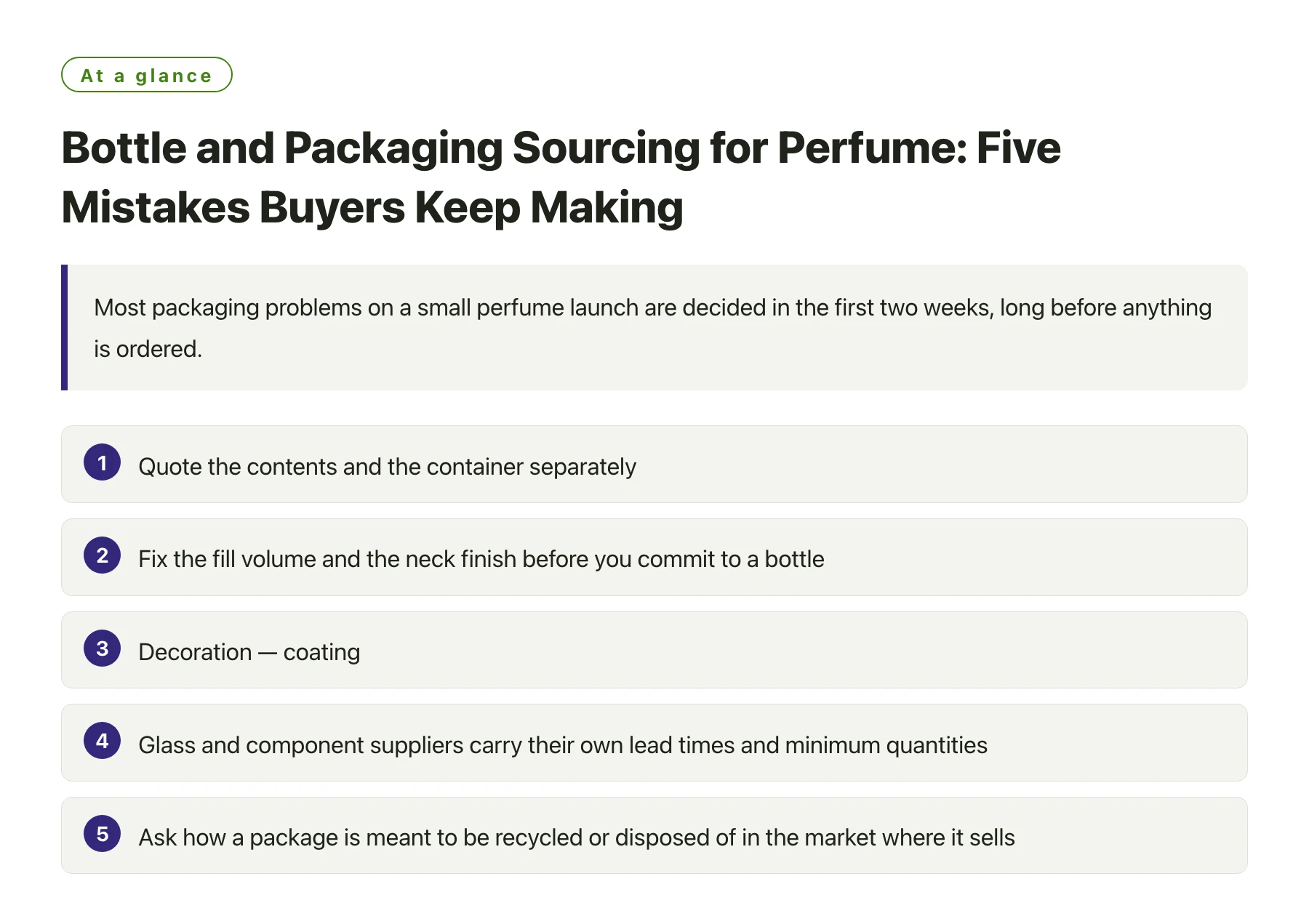
Key takeawaysQuote the contents and the container separately; a single blended price hides which supplier is expensive and makes any later change impossible to cost. · Fix the fill volume and the neck finish before you commit to a bottle, because changing either one after tooling or a stock order usually means re-buying the container. · Decoration — coating, printing, hot stamping, labelling — is normally the most variable part of a packaging budget and the easiest place to save money without changing the product. · Glass and component suppliers carry their own lead times and minimum quantities, so a packaging plan with one supplier's calendar in it will slip. · Ask how a package is meant to be recycled or disposed of in the market where it sells; packaging rules in several regions now reward designs that are easier to sort and lighter to ship [1].
A perfume bottle looks like a simple object and behaves like a small engineering project. It has a glass or plastic body, a neck with a defined finish, a pump or cap that must fit that finish, a decoration process with its own tolerances, and a secondary pack that has to survive shipping and satisfy retail.
Each of those parts has a different supplier, a different minimum quantity and a different lead time. When they are bought as a bundle, mistakes hide. When they are bought as separate lines, the buyer can see where the money is going and where the risk sits — which is the whole point of the exercise.
What follows are the five mistakes that come up most often in small launches, and the practical fix for each.
Mistake one: one blended price for juice and pack
It is comfortable to receive a single figure that covers everything from concentrate to carton. It is also the fastest way to lose control of a budget, because a blended price cannot be compared with another supplier's blended price unless both used the same bottle, the same label and the same fill weight — which they almost never did.
The fix is to ask for a breakdown with at least four lines: fragrance concentrate, container and closure, decoration work, and secondary packaging. If a supplier will not break the price down, ask for the pack specification on its own and price that part separately, which is usually available from a a private label partner for perfume lines even when the fragrance is sourced elsewhere.
Why this matters more on small orders
At high volume, component prices are negotiated annually and the blended number is reasonably stable. At low volume, the container often dominates the cost, because a small glass order carries setup, mould and printing charges that are spread over fewer units. Buying the pack as a visible line makes that reality obvious instead of surprising, and splitting the lines is also the fastest way to spot where a perfume quote can hide costs in a supplier's total.
Mistake two: choosing the bottle before the fill is fixed
A bottle is defined by more than its shape. The neck finish determines which pump, cap or dropper will fit; the internal volume determines how full the bottle looks; the glass wall thickness affects how much the product appears to cost. Change the fill volume after the bottles are ordered and the product may look under-filled, which is a positioning problem rather than a manufacturing one.
The sequence that avoids this is unglamorous but reliable: settle the fill volume and the neck finish first, then select the container, then select the closure, then plan decoration. Buyers who work in this order usually find that the number of available bottles is still wide open.
The five mistakes and what to do instead
| Mistake | Why it happens | What to do instead |
|---|---|---|
| One blended price for juice and pack | It is easier to compare a single number | Ask for four separate cost lines, then compare like with like |
| Bottle chosen before the fill is fixed | The pack is the visible, exciting decision | Lock fill volume and neck finish first, then shop for the container |
| Decoration treated as a detail | It is specified late, after the container is chosen | Price coating, printing and labelling alongside the bottle, not after |
| One supplier on the critical path | Buyers assume the factory supplies everything | Map each component to its supplier and confirm each lead time in writing |
| Packaging designed for the photo, not the market | Launch imagery is the priority at concept stage | Check how the pack is sorted, recycled or disposed of where it will be sold |
The fourth row is the one that causes schedule slips rather than cost overruns. A glass order, a pump order and a label print run are three separate queues, and the slowest one sets the date.
Mistake three: treating decoration as a finishing touch
Decoration is where a modest bottle becomes a premium one, and it is also where the budget quietly moves. Lacquering, frosting, metallising, screen printing, hot stamping and labelling each carry their own setup cost, minimum quantity and rejection rate. Two bottles that look similar on a shelf can differ substantially in unit cost because one is decorated in a single pass and the other in four.
The useful discipline is to specify decoration at the same time as the container. Then it can be costed, sampled and rejected as a package, instead of being added after the glass is already in production. Labels are often the cheapest route to a distinctive look, and they also allow the artwork to change between batches without touching the bottle.
Ask for a pre-production decorated sample
Screens and print files are not the same as a finished bottle. A decorated pre-production sample shows how the ink sits on the glass, how a metallic cap reads against the coating, and whether the label sits straight. Approving artwork without one is how brands discover a colour problem only after the run is complete.
Mistake four: ignoring where the pack ends up
Packaging regulation is moving in a consistent direction in several major markets: lighter material, fewer mixed materials, and designs that can actually be sorted and recycled. The European Commission's work on packaging and packaging waste is one clear example, setting requirements that affect what brands put on shelves in that market [1].
This is not only a compliance question. Shipping weight is a cost line, and a pump that cannot be separated from the bottle is a disposal problem that retailers increasingly notice. In the United States, the How2Recycle label administered by the Sustainable Packaging Coalition exists precisely because consumers need to be told how a package should be handled [2]. Checking disposal early is cheaper than redesigning later.
A practical test before any packaging order is placed: write the full bill of materials on one page — bottle, closure, decoration, label, carton, insert — with the supplier, the minimum quantity and the lead time for each line. Any line that is blank is where the schedule will slip. This takes twenty minutes and prevents most of the delays that small launches blame on the factory.
Mistake five: assuming one partner covers every part
Some manufacturers do handle bottle and packaging design alongside filling, which reduces the number of conversations a brand has to have. That is a genuine advantage on a first launch, and it is worth asking about early rather than late. But even an integrated partner is sourcing glass, pumps and labels from somewhere, and the brand still benefits from seeing the individual lead times.
The reason is simple: the brand carries the launch date, not the supplier. When a component is late, the market does not care which queue it was in. Asking for the component map is not a sign of distrust; it is how a brand knows when to start promoting. A manufacturer such as Xuelei Fragrance, for instance, describes bottle and packaging design as part of its scope, which makes the map easy to request in one place rather than three.
Sources
- European Commission: Packaging Waste and the PPWR —— EU rules on packaging and packaging waste, including the Packaging and Packaging Waste Regulation requirements on recyclability and design.
- Sustainable Packaging Coalition —— A membership organisation working on more sustainable packaging design, publishing material and recyclability guidance.
Frequently asked questions
Should I buy the bottle myself or let the factory supply it?
Letting the factory supply it usually shortens the project and avoids compatibility problems between the neck finish and the pump. Buying directly can be cheaper at large volumes or when you want a specific decorative container, but you then own the coordination risk between components.
What is the minimum order for a custom perfume bottle?
It depends on whether the bottle is a stock shape or a new mould. Stock shapes have the lowest minimums; a new mould or a bespoke decoration carries setup costs that only make sense at higher quantities. Ask both questions separately, because the answers often differ by a wide margin.
How far in advance should packaging be ordered?
Start before the fragrance sample is approved, since packaging lead times are frequently longer than the development schedule. The decisive number is the slowest single component — often the decorated glass or a custom cap — so map each item's lead time and plan backwards from the launch date.
Is a heavier bottle always better for a premium product?
Weight signals quality to many consumers, but it also raises shipping cost and material use. The more useful question is whether the pack feels deliberate in the hand and matches the price point. A well-decorated lighter bottle often outperforms a heavy plain one at the same total cost.
Can labels replace decoration on the bottle?
Often yes, and it is usually the cheapest way to achieve a distinctive look. Labels also let the artwork change between batches without a new glass order, which is useful for limited editions, seasonal variants and small first runs.