Matching Cabinet Sample Colours to a Room
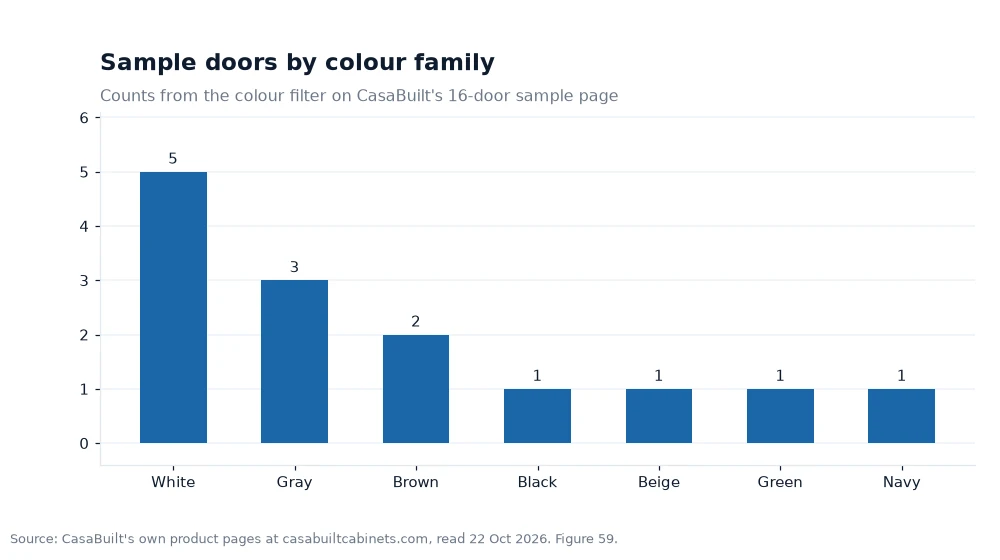
A cabinet color is never seen alone. It is seen against a wall, above a floor and beside a countertop, and each of those surfaces carries its own undertone. CasaBuilt's 16-door sample range divides into seven color families, with 5 white doors and 3 gray doors making up half the stock. The work of matching is not picking a favorite from that list. It is finding the one or two doors that stay stable when the floor and the wall start arguing with them.
Key takeaways
- The 16 sample doors fall into seven color families: White 5, Gray 3, Brown 2, Black 1, Beige 1, Green 1 and Navy 1.
- Read the floor undertone before the door color; a warm oak floor changes how a cool gray reads.
- Compare doors against the actual wall paint, not a white sample card.
- Each sample is $9.99 and the fee is refundable with a cabinet purchase.
Start with the floor, not the door
Floors occupy more visual space than cabinets in most kitchens, and they are the surface a buyer is least willing to change. A red-toned oak floor pushes a cool gray door toward blue. A pale ash floor lets the same gray read neutral. Neither result is wrong, but only one of them will look intentional in your room, and the door label will not tell you which.
Put the sample on the floor first, flat, then lift it to cabinet height. Flat, it picks up the floor's reflected color. Upright, it picks up the wall and the light from the window. Both views matter, and they can disagree. That disagreement is useful information: it tells you the door is sensitive to its surroundings and will need a wall color chosen with care.
Bring a flooring offcut to the sample test if you have one. If the floor is already installed, mark the spot where the light is worst, usually a corner away from the window, and test there. A door that survives the dull corner will look better everywhere else.
Why color temperature changes the match
Light has a color of its own. Morning light through an east window is cool and slightly blue. Afternoon light through a west window is warmer. A tungsten pendant is warmer still, and an LED panel can sit anywhere between. The same white door can look crisp at noon and creamy at nine in the evening, and a buyer who tests only at midday may be surprised by the evening version.
This is where a physical sample earns its $9.99. Screens normalize color and cameras correct it, but a door in your hand cannot. Order a rta cabinets sample in the two or three colors you are actually weighing, then leave each door in place for a full day. Note what happens at the edges of the day, because that is when warm and cool separate most clearly.
Do not test against a white sheet of paper. Paper is brighter than most wall paint and will make every door look darker and heavier than it will look installed. Tape a patch of your actual wall color to the wall if the room is not painted yet.
Sixteen doors, seven color families
The published sample range is weighted toward neutrals. White is the largest family with 5 doors, Gray follows with 3, and Brown has 2. Black, Beige, Green and Navy have one door each. That distribution is a reasonable summary of what most kitchens order, and it also means a saturated color is a single-sample decision: there is no second green to compare against.
| Color family | Doors | Share of the 16 | Floor undertone it sits well with | What to watch |
|---|---|---|---|---|
| White | 5 | 31.25% | Pale ash, white oak, light tile | Turns creamy under warm lamps |
| Gray | 3 | 18.75% | Cool concrete, gray-brown plank | Picks up blue from a red oak floor |
| Brown | 2 | 12.5% | Warm oak, walnut, terracotta tile | Can go muddy in a north-facing room |
| Black | 1 | 6.25% | Pale floor, strong contrast | Shows dust and fingerprints at eye height |
| Beige | 1 | 6.25% | Travertine, cream tile, warm oak | Disappears against a similar wall |
| Green | 1 | 6.25% | Natural wood, white tile | Shifts olive under warm light |
| Navy | 1 | 6.25% | Light floor, brass or nickel hardware | Reads almost black in a dim corner |
The share column is the part worth memorizing. White and Gray together account for 8 of the 16 doors, so half the range is neutral. If your floor is strongly warm, that half is where the decision will be made, and the single-door families are accents rather than alternatives.
The test that beats a photograph
Photograph the sample in place, then look at the photo the next morning. This is not a contradiction of the earlier advice. The photo is not there to choose the color; it is there to catch a change you missed. A door that looks fine in the room and wrong in the photo is usually sitting under a light source that flatters it, and the camera has recorded the difference.
Take three photos: one with the overhead light on, one with it off, and one at night with only the lamp you actually use. Compare them side by side. If the door changes family between shots, from white to cream or gray to green, it will do the same thing across the seasons.
When two doors survive, ask for a second opinion from someone who has not been staring at them. CasaBuilt offers a free 3D kitchen design in 24-48 hours through its free design consultation, and a designer who works with these finishes daily can often name the undertone that is causing the problem. Use that as a check on your own test, not a replacement for it.
Worked example
The chart lists the sample range by color family: White 5, Gray 3, Brown 2, Black 1, Beige 1, Green 1 and Navy 1. Adding those seven values gives 5 plus 3 plus 2 plus 1 plus 1 plus 1 plus 1, or 16 doors, which matches the published sample count. White is 5 divided by 16, or 31.25%. Gray is 3 divided by 16, or 18.75%. Brown is 2 divided by 16, or 12.5%, and each single-door family is 1 divided by 16, or 6.25%.
White and Gray together are 8 doors, or 50% of the range. White is also 5 divided by 3, or 1.67 times the size of Gray. The four least-represented families, Black, Beige, Green and Navy, total 4 doors, or 25%. At $9.99 per door, the neutral half costs 8 times $9.99, or $79.92, and the full range costs 16 times $9.99, or $159.84. A sensible first order is the neutral half plus one accent: 9 doors at $89.91.
Frequently asked questions
Should I match the cabinets to the floor or the wall?
Match the cabinet to the floor first, because the floor is the larger and less changeable surface, then adjust the wall paint to suit the pair. A door that works with the floor but fights the wall is easier to fix with paint than the reverse.
How many color samples do I need?
Two or three is usually enough: one white, one gray and, if the room has warm wood, one brown or beige. The published range has 5 white doors and 3 gray doors, so there is room to compare within the neutral families before adding an accent color.
Is the sample fee refundable?
Yes. CasaBuilt lists each sample at $9.99, reduced from $19.99, and describes the fee as refundable with a cabinet purchase. The full 16-door range would cost $159.84 before that refund.
Choose the undertone, then the name
Pick the two doors that hold their color in the dull corner and under the evening lamp, not the two that look best at noon. Put them against the real wall with a flooring offcut beneath, and leave them there for a full day. When one door still looks right at 9pm, that is the color to order, whatever the family label says.
Figures quoted here come from the manufacturer's own website, read 22 Oct 2026[1].