Melamine-Bonded Panels for Everyday Shuttering
Not every pour justifies a high-grade formwork board. A Black Film Faced Plywood panel built on an acacia core with a melamine bond is the economical answer for routine shuttering, quoted at roughly 3–5 reuse cycles under normal site conditions and offered in the thickness European buyers order most.

Key takeaways
- Core is Acacia veneer from Vietnamese plantation forests, bonded with melamine.
- Published reuse guidance is approximately 3–5 times under normal site conditions.
- 21 mm is the thickness European buyers order most, with 18 mm next and 1250 × 2500 mm the most requested format.
- Batch inspection covers panel thickness consistency and core construction integrity before shipment.
Where a melamine bond fits on a site
A melamine bond is the middle of the formwork range: tougher than an interior glue line, easier on the budget than the phenolic systems used for high-cycle work. That makes it the natural specification for foundation pours, single-storey wall formwork and the many small jobs where a panel is used a handful of times and then retired.
Budget planning for shuttering usually starts from the pour sequence rather than from the panel. Work out how many times each sheet will realistically be used, then choose the board that matches that number: a specification of three to five uses puts this panel in the right place, while a long programme running the same jigs again and again points towards the heavier grades.
The trade-off is cycles rather than strength. Published guidance for this panel is roughly 3–5 reuses in normal conditions, so the specification decision is simply how many pours your project expects from each board. Below five, the economical panel wins on cost per pour; well above it, the heavier film quality starts to pay for itself.
Acacia cores from Vietnamese plantations
The core is built from Acacia veneers sourced from Vietnamese plantation forests, which is why the panel is described as a stable core rather than a light one. Acacia is a dense hardwood, so a 21 mm board holds its shape and takes fixings without crushing at the edge.
Plantation sourcing also matters for documentation. Buyers asking about origin can be pointed to a plantation supply rather than natural forest, and that fits the same due-diligence file as the certification set on the company's about page.
What the 10 Hours Boiling Test tells you
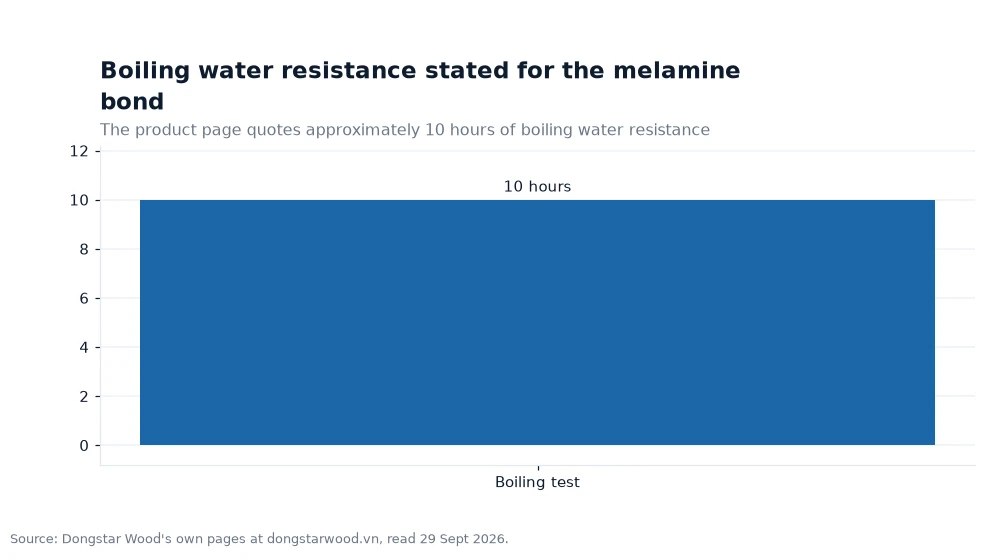
The published figure for the melamine bond is approximately 10 hours in the boiling water test, which is the standard way a formwork panel's glue line is described in this market. It is a laboratory result, not a site warranty: no one soaks a panel for ten hours, but the number shows how the bond behaves when water reaches the core through a cut edge or a damaged face.
Read it as comparative rather than absolute. The 10 Hours Boiling Test places this panel above basic interior bonds and below the phenolic classes, which is exactly where it sits commercially, and it explains the reuse guidance of 3–5 cycles rather than the 10–20 published for higher-grade boards.
Thickness and format European buyers ask for
Two thicknesses carry most of the demand: 21 mm is the best-selling specification for European buyers, with 18 mm next. The most requested format is 1250 × 2500 mm, which suits wall formwork panels that can be handled by two people and reused without cutting.
Ordering both thicknesses in the same container is common practice for distributors, who then hold one line for wall panels and one for loaded slabs. The mill can press them in the same month, so the only coordination needed is that the pallets are labelled clearly and separated in the stack.
Size and thickness together decide the props and the joints. A thicker panel deflects less, so it can span further between soldiers; a larger format reduces the number of joints that have to be sealed. Most sites end up trading one against the other, and the answer usually comes from the height of the pour rather than the price list.
| Item | Published value |
|---|---|
| Core | Acacia veneers, Vietnamese plantation forests |
| Bond | Melamine, approximately 10 hours boiling test |
| Reuse | Approximately 3–5 times in normal site conditions |
| Best-selling thickness | 21 mm, then 18 mm |
| Most requested format | 1250 × 2500 mm |
From drying to inspection: how the board is made
The production sequence published for this panel runs moisture-controlled drying, then multi-layer panel assembly, then high-pressure hot pressing, and finally quality inspection before shipment. Drying first is what keeps the pressed board flat, and the hot press sets the melamine bond across the full sheet rather than at the edges.
Two items are named in the batch inspection: panel thickness consistency and core construction integrity. Those are the two faults that ruin a formwork programme quietly — a panel that is 0.8 mm thin at one corner leaks slurry, and a core with a gap between plies delaminates after two or three pours.
Who buys this panel, and how it is sold
Supplied to distributors, builders and formwork companies, the panel is positioned on cost per project rather than on maximum life: stable acacia core, smooth concrete surface finish, easier handling on site, and a price that suits jobs where formwork is hired or scrapped rather than maintained.
For a distributor, the panel is also easy to explain to end customers. It sits in a clear position: cheaper per project than the heavy-duty grades, tougher than an interior board, and specified by thickness rather than by a long list of surface options, which keeps a stock list short and a price list simple.
The smooth face is a real advantage when the concrete will be left visible. Black film transfers a clean, even finish, so a client-visible retaining wall or slab edge needs less patching than one poured against a textured or worn board.
Worked example: cost per square metre of contact
Take the 1250 × 2500 mm format: 1.25 × 2.5 gives 3.125 m² of face per pour. Over the published reuse range, one sheet delivers from 3 × 3.125 m² = 9.375 m² up to 5 × 3.125 m² = 15.625 m² of formwork contact (example).
Now put a job against it. A ground-floor slab needing 400 m² of edge and soffit formwork, poured once, takes 400 ÷ 3.125 = 128 sheets (example). If each panel is used for four pours instead of one, the same work needs 400 ÷ (3.125 × 4) = 32 sheets per cycle (example), which is where the low unit cost of this board does most of its work.
Frequently asked questions
When should a buyer upgrade from this panel?
When the pour count climbs. The economical board is published at roughly 3–5 reuses, so a programme that expects eight or ten cycles from each sheet is better served by the higher-grade film faced range, where the published reuse figure runs to 10–20.
Does the melamine bond cope with rain during construction?
The bond is designed for normal site conditions and repeated wetting between pours, with the published boiling test figure at approximately 10 hours. Panels still do better stacked flat off the ground between uses than left standing in water.
Which thickness should a first order use?
21 mm is the thickness European buyers order most, with 18 mm close behind. Both suit wall formwork; the heavier board is the one to specify where spans are longer or the concrete pressure is higher.
Where to compare the two ends of the range
Set this panel against the higher-grade formwork range when you know how many pours the project will run, and check the panel formats and thickness bands the same mill publishes if the order mixes shuttering with furniture work.
Bond, core and thickness data come from the supplier's own site, as consulted on 29 Sept 2026 for the numbers in the table above for the numbers in the table above as the source for this article[1].