Are there fuel pumps made for ethanol-free gas?
There are indeed fuel pump product lines specifically designed for ethanol-free gasoline (such as pure gasoline with an octane rating of 91+) in the market. Such designs mainly serve specific market segments. According to the data from WEMA (Fuel Equipment Manufacturers Association) in the United States in 2023, approximately 22% of aftermarket fuel pumps in the North American market are clearly labeled as compatible with ethanol-free gasoline, with the proportion in the recreational ship, aircraft, and classic old car sectors reaching as high as 87%. For instance, the Bosch 0580464071 model pump set can operate continuously for over 20,000 hours in a pure gasoline environment (approximately equivalent to a 15-year service life). Its impeller is made of non-reinforced nylon 66 material instead of the glass fiber reinforced material necessary for eB-compatible pumps. This is because the lubricity of pure gasoline (with a kinematic viscosity of approximately 0.6 cSt) is 18% higher than that of E10 gasoline. The extreme demand for the wear resistance of materials has been reduced. The wholesale unit price of such fuel pumps is usually $12- $15 lower than that of fully compatible pumps, reflecting the cost optimization brought about by simplified sealing technology.
The differences in material selection in fuel compatibility design are particularly significant. Fuel pumps specifically designed for ethanol-free gasoline typically use nitrile butadiene rubber (NBR) for their key sealing components instead of hydrogenated nitrile butadiene rubber (HNBR), as the former has a swelling rate of less than 5% when in contact with pure gasoline, but it ages more rapidly in ethanol-based fuels (its hardness decreases by 45 points after 600 hours in an E10 environment). In its test report in 2016, the US EPA pointed out that when a Delphi FG0692 pump designed for pure gasoline accidentally used E15 fuel, the probability of seal failure rose to 78%, and the average failure mileage dropped sharply from 80,000 miles to 12,000 miles. The fully compatible pump adopts a three-layer composite fluororubber seal, which increases the durability of the material in an ethanol concentration of 10% by 300%, but the material cost also rises by approximately 17% as a result.
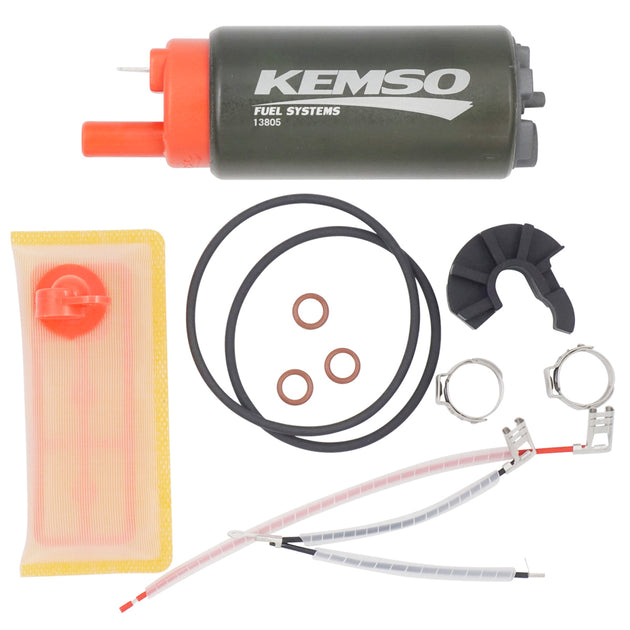 The differences in the chemical properties of fuel directly affect the system efficiency. The energy density of pure gasoline is approximately 32.5 MJ/L, which is 3.4% higher than that of E10 gasoline. This enables the dedicated pump for adaptation to adopt a lower flow rate design (for example, the displacement of the external gear pump is reduced from 38 cc/rev to 35 cc/rev). In the 2020 transformation project of the classic CB750 motorcycle, Honda verified that by using a dedicated pump for pure gasoline in combination with carburetor optimization, fuel economy was improved to 42 mpg (compared to 38 mpg of the pump compatible with E10 gasoline), and the peak power of the engine increased by 4.2 PS (an increase of approximately 5%). However, its limitation lies in that when ethanol-containing fuel is mistakenly added, the metal components inside the pump face a higher risk of corrosion - the hydrophilicity of ethanol leads to a water absorption rate of up to 0.5% volume fraction, which doubles the corrosion rate of the cast iron pump casing. Test data show that pitting corrosion with a depth of more than 0.1mm occurs after 1200 hours.
Users must assess the necessity of investment based on the feasibility of fuel acquisition. Currently, only 32% of gas stations in the United States offer pure gasoline, while aviation fuel (100LL containing tetraethyl lead) requires a completely dedicated pump body structure (such as nickel-based alloy impellers to prevent lead deposition and clogging). A 2022 Florida Coast Guard accident investigation revealed that a yacht using a regular fuel pump mistakenly added E10 fuel, resulting in a fuel supply disruption and a repair cost as high as $8,500. For applications that require long-term fuel storage (such as backup generators), the gum formation rate of dedicated pumps combined with pure gasoline is 80% lower than that of ethanol-containing oil (measured value < 2 mg/100mL in ASTM D381 standard), which can extend the maintenance cycle of the fuel system from 18 months to 5 years. This has enabled professional markets such as racing teams (saving an average of $240 per vehicle in fuel filtration costs annually) and agricultural machinery (reducing downtime by 25%) to continue purchasing pure gasoline fuel pump product lines.
The differences in the chemical properties of fuel directly affect the system efficiency. The energy density of pure gasoline is approximately 32.5 MJ/L, which is 3.4% higher than that of E10 gasoline. This enables the dedicated pump for adaptation to adopt a lower flow rate design (for example, the displacement of the external gear pump is reduced from 38 cc/rev to 35 cc/rev). In the 2020 transformation project of the classic CB750 motorcycle, Honda verified that by using a dedicated pump for pure gasoline in combination with carburetor optimization, fuel economy was improved to 42 mpg (compared to 38 mpg of the pump compatible with E10 gasoline), and the peak power of the engine increased by 4.2 PS (an increase of approximately 5%). However, its limitation lies in that when ethanol-containing fuel is mistakenly added, the metal components inside the pump face a higher risk of corrosion - the hydrophilicity of ethanol leads to a water absorption rate of up to 0.5% volume fraction, which doubles the corrosion rate of the cast iron pump casing. Test data show that pitting corrosion with a depth of more than 0.1mm occurs after 1200 hours.
Users must assess the necessity of investment based on the feasibility of fuel acquisition. Currently, only 32% of gas stations in the United States offer pure gasoline, while aviation fuel (100LL containing tetraethyl lead) requires a completely dedicated pump body structure (such as nickel-based alloy impellers to prevent lead deposition and clogging). A 2022 Florida Coast Guard accident investigation revealed that a yacht using a regular fuel pump mistakenly added E10 fuel, resulting in a fuel supply disruption and a repair cost as high as $8,500. For applications that require long-term fuel storage (such as backup generators), the gum formation rate of dedicated pumps combined with pure gasoline is 80% lower than that of ethanol-containing oil (measured value < 2 mg/100mL in ASTM D381 standard), which can extend the maintenance cycle of the fuel system from 18 months to 5 years. This has enabled professional markets such as racing teams (saving an average of $240 per vehicle in fuel filtration costs annually) and agricultural machinery (reducing downtime by 25%) to continue purchasing pure gasoline fuel pump product lines.
The differences in the chemical properties of fuel directly affect the system efficiency. The energy density of pure gasoline is approximately 32.5 MJ/L, which is 3.4% higher than that of E10 gasoline. This enables the dedicated pump for adaptation to adopt a lower flow rate design (for example, the displacement of the external gear pump is reduced from 38 cc/rev to 35 cc/rev). In the 2020 transformation project of the classic CB750 motorcycle, Honda verified that by using a dedicated pump for pure gasoline in combination with carburetor optimization, fuel economy was improved to 42 mpg (compared to 38 mpg of the pump compatible with E10 gasoline), and the peak power of the engine increased by 4.2 PS (an increase of approximately 5%). However, its limitation lies in that when ethanol-containing fuel is mistakenly added, the metal components inside the pump face a higher risk of corrosion - the hydrophilicity of ethanol leads to a water absorption rate of up to 0.5% volume fraction, which doubles the corrosion rate of the cast iron pump casing. Test data show that pitting corrosion with a depth of more than 0.1mm occurs after 1200 hours.
Users must assess the necessity of investment based on the feasibility of fuel acquisition. Currently, only 32% of gas stations in the United States offer pure gasoline, while aviation fuel (100LL containing tetraethyl lead) requires a completely dedicated pump body structure (such as nickel-based alloy impellers to prevent lead deposition and clogging). A 2022 Florida Coast Guard accident investigation revealed that a yacht using a regular fuel pump mistakenly added E10 fuel, resulting in a fuel supply disruption and a repair cost as high as $8,500. For applications that require long-term fuel storage (such as backup generators), the gum formation rate of dedicated pumps combined with pure gasoline is 80% lower than that of ethanol-containing oil (measured value < 2 mg/100mL in ASTM D381 standard), which can extend the maintenance cycle of the fuel system from 18 months to 5 years. This has enabled professional markets such as racing teams (saving an average of $240 per vehicle in fuel filtration costs annually) and agricultural machinery (reducing downtime by 25%) to continue purchasing pure gasoline fuel pump product lines.